
It has been a little over a month since Binance announced the launch of its stock business on June 1.
According to data disclosed by the official platform, of over 7,000 tradable US stocks and ETFs, more than 700 have been traded. As of the week of July 1, the net exposure gained by Binance stock users was 193.3 million USD, exceeding 190 million USD for the second consecutive week.
In terms of tokenized stocks, bStocks was also launched on June 11.
After a month, do spot stocks have real buyers, what are users mainly buying, and has bStocks found its own usage scenario?
Let’s take a closer look below.
1. First Month Transaction Breakthrough, Buying Focused on Emerging Markets
First, let’s look at the spot stock segment.
Binance offers spot stocks covering over 7,000 US-listed stocks and ETFs, supporting fractional share purchases, stablecoin settlement, and extended trading hours. On July 6, Binance continued to add stocks like ANTA, CBRS, DISK, FOTO, KMEM, QNT, STRC, etc. In terms of transaction structure, Nest Trading is responsible for order referrals, and Alpaca Securities is responsible for execution, clearing, settlement, and custody.
From the usage rate, according to Binance Research, over 700 of more than 7,000 assets have been traded. This number indicates, on one hand, that this segment of business is not just a facade, with about 10% of the assets being reached by users within a month. On the other hand, it also indicates that early demand has not spread evenly; users are not treating Binance as a complete US stock supermarket.
In terms of capital flow, reports show that as of the week of July 1, Binance stock users had a net increase of 193.3 million USD in stock exposure, while the previous week it was 227.3 million USD. Although this represents a 15% decrease, it has remained above 190 million USD for two consecutive weeks.
As for the source of buying, users from emerging markets contributed 81% of the net inflow, holding steady for two weeks. Regarding the number of users, another previous report by Binance Research indicated that nearly 93% of Binance stock trading users are from emerging markets.
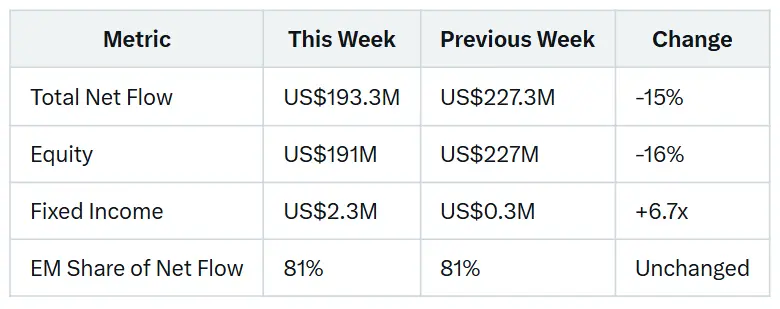
Image Source:Binance Equity Weekly Fund Flow
This indicates that Binance is not grabbing users in the most mature markets of traditional brokerages but is finding a group willing to buy US stocks directly with stablecoin accounts in markets with weak cross-border access, dollar asset allocation, and local brokerage experiences.
Thus, it can be seen that early buying in Binance stocks has emerged. However, this batch of buying has not been evenly distributed across more than 7,000 assets; instead, it is concentrated on certain high-interest assets and users from emerging markets.
2. Technology Sector Attracts 83% of Net Inflows, Features of Thematic Trading Evident
If looking only at net inflows, Binance's stock business does indeed have certain demand. The more important question is, what type of demand is it?
From the weekly report data released by Binance, as of the week of July 1, the technology sector absorbed 159 million USD in net inflows, accounting for 83% of all net inflows, with a high degree of concentration in trading themes.
Micron's earnings report was the most evident catalyst of that week. After Micron released strong performance after market close on June 24, the AI storage theme shifted from a net outflow of 1 million USD the previous week to a net inflow of 47 million USD. Funds flowing into the semiconductor industry increased from 22 million USD to 108 million USD, nearly a fivefold increase.
On the level of individual stocks, stocks in the AI storage and semiconductor chains like MU, MUU, SNDK, AMAT, INTC absorbed a large amount of capital. MU combined with the 2x leveraged product MUU received a total net inflow of 58 million USD, accounting for about 30% of the week's net inflow in stocks.
This capital is not entirely without thought. The weekly report shows that users had a net sell of 11 million USD in MUU the week before the earnings report, and then a net buy of 24 million USD after the report was confirmed.
This indicates that Binance stock users have a higher risk preference, but it is not simply a high-leverage impulse. They reduce risk around events and then add positions again after outcomes are confirmed.
The report also states that about 71% of the stock holders in Binance's stock products are allocated to the technology sector, with around 48% of funds flowing to semiconductors, and this category's trading volume is about 23 times that of other categories.
In terms of thematic capital flows, 25% flows into AI infrastructure and computing power, 22% flows into quantum computing, and there is also relatively high configuration in frontier themes such as space and satellites, robotics, and humanoid robots. During the same period, broader ETF capital flows were mainly concentrated in semiconductors and AI storage.
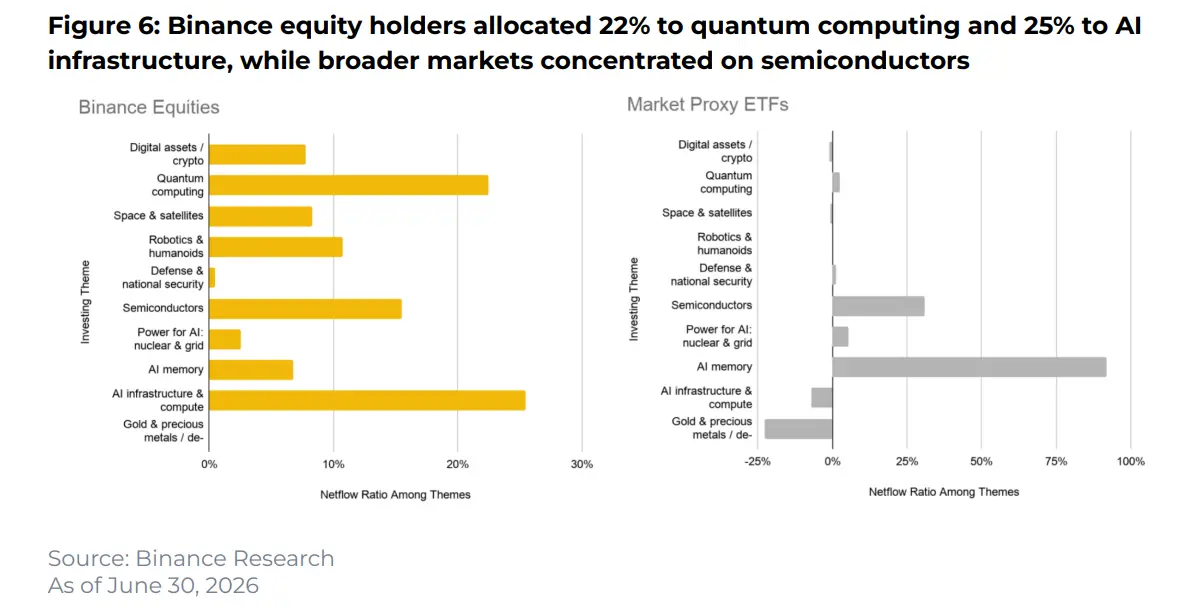
On the other hand, thematic switches occur extremely quickly. The previously hottest theme of defense and national security saw net inflows drop from 150 million USD to 3 million USD in this week, a decline of 98%. SpaceX-related capital also retreated from its high, yet SPCX still recorded a net inflow of 29 million USD, continuing to rank among the top in single-stock inflows.
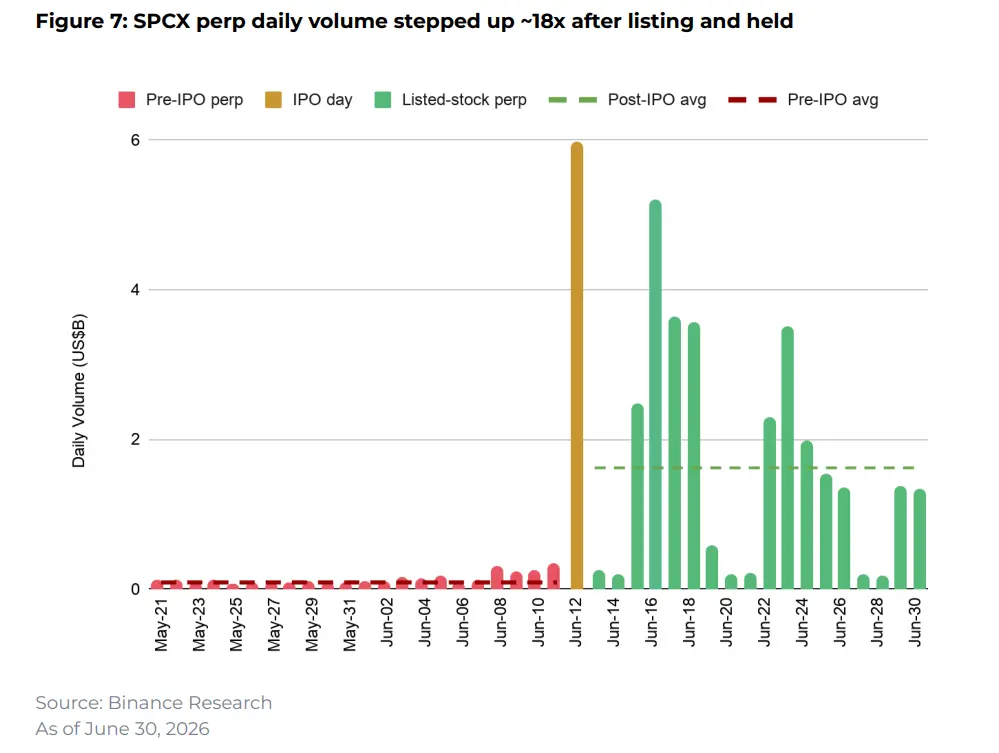
This set of changes is very representative. Binance stock users are not buying a traditional long-term US stock portfolio, but rather high-narrative assets such as AI, semiconductors, quantum computing, SpaceX, Tesla, and Circle. They observe earnings reports, policies, mergers, and market sentiments, with trading logic closer to the catalysts and volatility familiar to crypto users.
This also explains why users from emerging markets would become the main force. For many emerging market users, the cost of buying US thematic stocks, leveraged ETFs, or popular private placements through local brokerages is high, the pathways are long, and the experience is poor. Binance integrates stablecoins, spot stocks, and thematic assets into the same account, thereby lowering not the total investment threshold, but rather the expression threshold for trading needs.
Therefore, the early buying behavior emerging from Binance's spot stocks is more about themed trading demands.
3. Tokenized Stocks Under Pressure Testing, Uncertainties in On-Chain Shares Remain
Next, let’s examine the tokenized stock business.
Binance officially states that bStocks belong to tokenized securities, which are certificates representing specific financial instruments and do not equate to direct ownership of stock or shares in the underlying listed companies.
Spot stocks answer whether users can buy US stocks on Binance. What bStocks answers is whether users still want to trade US stock exposure when the US stock market is closed.
According to the bStocks report released by Binance Research on July 2, bStocks showed that approximately 44% of the trades occurred outside regular US trading hours, while matching spot stocks were around 32%. During weekends when the US stock market is completely closed, bStocks still averages about 346,000 USD traded per hour.
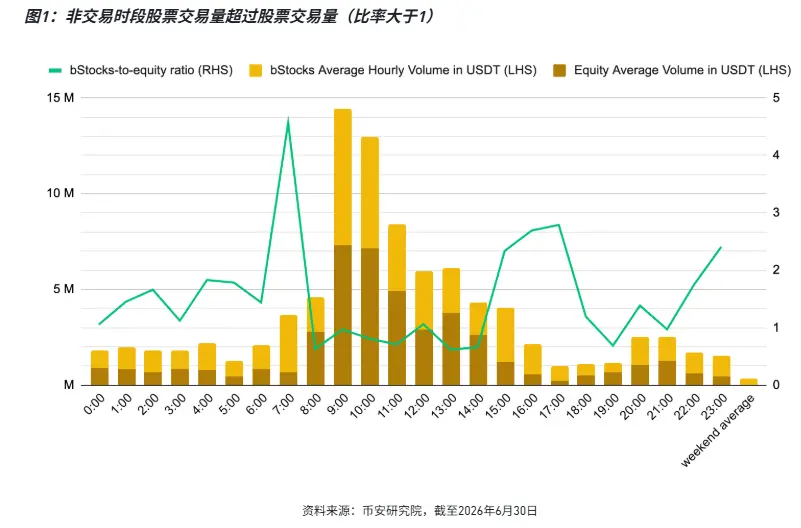
Among them, in the pressure tests conducted during three holiday weekends, bStocks reflected 87% of Monday opening price changes in advance, accurately predicting 21 out of 22 directional judgments, achieving an accuracy rate of 96%. During the Juneteenth long weekend, the price difference between bStocks and regulated markets averaged about 0.12%, the smallest among the three tests.
Specifically, the confirmation of SpaceX's 60 billion USD acquisition of Cursor occurred before US stock market opening, and the tokenized SPCX had already completed a rise and fall before the opening. The Micron earnings report was released two minutes after the US stock market's closing, with MUB rising 7% within 5 minutes and 13% within 1 hour, basically completing the re-pricing before the next day's opening.
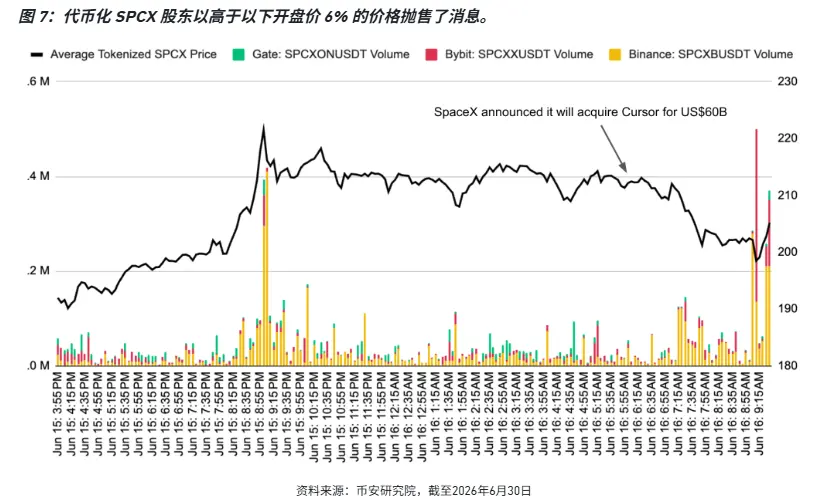
These data indicate that the genuine usage scenario for bStocks is very specific. It is not because everyone wants to put stocks on the blockchain, but because there are still people wanting to trade US stock exposure when the market is closed.
However, the demand for tokenized stocks being valid does not mean that bStocks has captured the largest share.
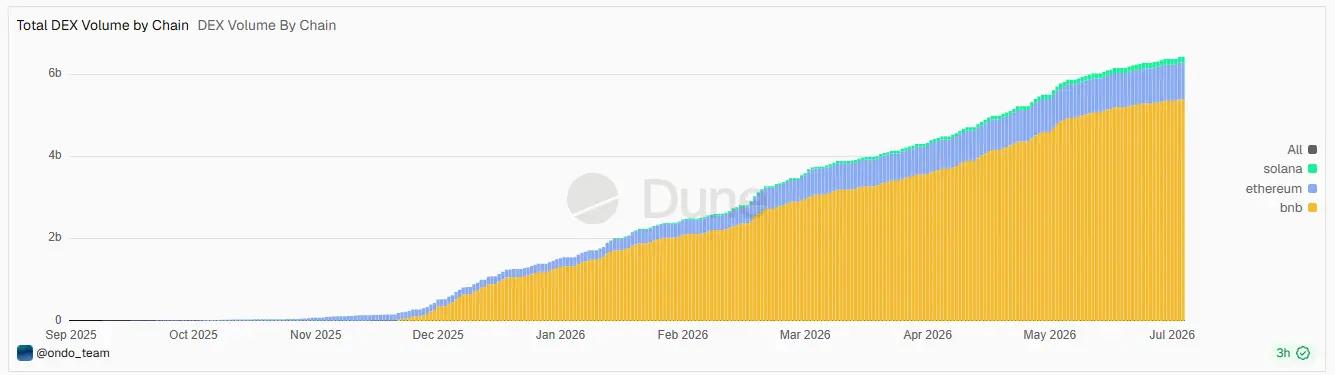
On June 26, the BNB Chain official disclosed that there are already more than 709 tokenized stocks and ETFs on the BNB Chain, with a cumulative trading volume exceeding 5 billion USD and a market value exceeding 1 billion USD. Meanwhile, tokenized versions of the same company on the BNB Chain may not be limited to one type; for instance, SpaceX has tokenized versions such as bStocks' SPCXB, Ondo's SPCXon, and xStocks' SPCXx.
Moreover, it is worth mentioning that Ondo is a major site for trading tokenized stocks on the BNB Chain. According to Dune data, BSC accounts for about 51.2 billion USD of Ondo's approximately 60 billion USD cumulative DEX trading volume. This means that while the demand for on-chain tokenized stocks may have been validated, this portion of growth may not primarily belong to bStocks.
Conclusion
A month has passed, and about 10% of the assets in spot stocks have been reached by users, but overall the scale is limited and concentrated among emerging market users and a few major assets.
This demand has emerged in a regulatory backdrop that is not entirely calm. On June 24, Binance withdrew its MiCA license application submitted in Greece, and after the transition period ended on July 1, notified users in multiple EU countries to suspend certain services and stop registering new users.
Regarding bStocks, the usage scenario of trading US stock exposure during market closures has been validated, and the speed of price discovery has withstood several holiday pressure tests. However, within the entire ecosystem of tokenized stocks, a significant portion of the trading volume has flowed to third parties like Ondo, and bStocks' own share does not have independent data support.
Overall, after one month of the launch of Binance's stock business, there is indeed a real demand. However, this demand seems more like a trading need of crypto users after migrating to US stocks, focusing on narratives and events rather than long-term allocations.
Disclaimer: This article represents only the personal views of the author and does not represent the position and views of this platform. This article is for information sharing only and does not constitute any investment advice to anyone. Any disputes between users and authors are unrelated to this platform. If the articles or images on the webpage involve infringement, please provide relevant proof of rights and identity documents and send an email to support@aicoin.com. The relevant staff of this platform will conduct an investigation.